About SST & EDM
News #
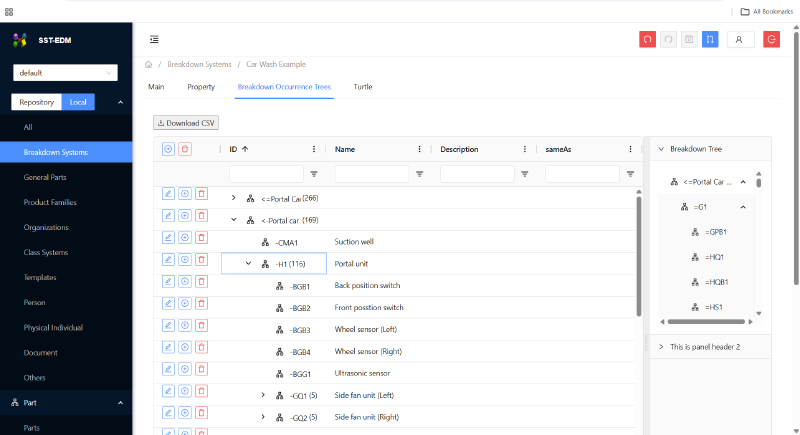
2026-07-25: SST-EDM MVP (Minimum Viable Product) is released for public access at https://edm.semanticstep.net/. A main highlight that users might to try out is the IEC/ISO 81346 support on Breakdown Systems using RDS - Reference Designation Systems. MVP release means that not all needed functionalities are yet available. Towards the end of 2026 SST-EDM will be available as a full featured product. It will then be available under two licenses:
- free of charge for small designs and testing without a time limit
- commercial license with full access and guaranteed memory space
2026-04-27: SST-Core v1.0.0 is released and available under either a commercial license or under the POLYFORM Noncommercial 1.0.0 license. The sources are available on https://github.com/semanticstep/sst-core ; see News
Overview #
Semantic STEP Technology (SST) is a tool for the development of web services and other applications that focuses on all kinds of industrial products data, including the design, production, maintenance and use of these products. All application data in SST is stored internally using Semantic Web technology as defined by W3C. Because of this SST-Data is always available in full detail to the creators of this data and ready to be shared with others on the Internet.
SST-EDM, Engineering Data Management, is a first web application for industrial user that is using the underlying SST-Core capabilities. The focus is on CAD, CAM, ERP, PDM related data. Breakdown structures on the basis of IEC 81346 Reference Data Systems (RDS) is the first supported application area. Electrical Wire Harnesses design is currently under development and this will directly support data exchange on the basis of STEP AP242 (ISO 10303-242:2025). Other application areas to follow.
SST Data Modelling Parts / Open Data #
The foundation of the SST/EDM ontologies (data modelling) is the unique combination of three series of standards:
- Semantic Web technologies: RDF/S, XSD, OWL, …
- ISO 15926 for the “Integration of life-cycle data for process plants, including oil and gas production facilities”
- ISO 10303, STEP, the standards for industrial product data that is widely supported by CAD systems, with a focus on STEP AP242
Other major data modelling parts are added to cover:
-
ISO 8000 for the Quantities and Units as the basis to define all kinds of properties
-
Dictionary data as defined in
-
ISO 13584 Part Library
-
IEC 61360 Common Data Dictionary
-
ISO 13399 Cutting Tools
-
eClass
-
-
IEC 81346 Reference Designation Systems
Sir Tim Berners-Lee the inventor of the World Wide Web and founder of the World Wide Web Consortium (W3C) says: “The Semantic Web is an extension of the current web in which information is given well-defined meaning, better enabling computers and people to work in cooperation” . Basis for any kind of data in the Semantic Web is RDF, the Resource Description Framework, that breaks down each piece of information into statements, consisting of a subject, a predicate and an object, called triples. The basis of the well-defined meaning is given by OWL, the Web Ontology Language that is defined on a mathematical basis. And for the exchange of RDF data there is Turtle (*.ttl files) and JSON-LD (JSON Linked Data) that works efficiently for Web-browsers. Together these Semantic Web standards define the foundation of SST.
STEP on the other hand is an International Standard for the computer-interpretable representation of product information with the objective to “provide a neutral mechanism capable of describing products throughout their life cycle” in a way that is suitable for data exchange, data integration and archiving. While STEP is very powerful and successful in some areas (e.g. 3D models) it is less successful in other areas (e.g. PLM - product lifecycle management, PDM - product data management). A reason is the week semantic basis of some core concepts of STEP that requires the generation of non useful data and that makes it difficult to use together with OWL.
ISO 15926 was developed by the same ISO technical subcommittee as STEP (ISO TC184/SC4) and was originally planned as a potential successor of STEP. It defines a very systematically basic structure for all things around us, together with a rather effective 4D concept to document the changes of things in space and time. Part 12 of ISO 15926 defines a rather effective mapping of these concepts into OWL. A disadvantage of ISO 15926 is that it also defines several highly abstract concepts (e.g. a class_of_class_of_class) whose practical usefulness is questionable.
SST is the combination of these three series of standards in the following way:
-
OWL is originally defined to support logical reasoning (also called inferencing) on the underlying RDF data; but this reasoning can take a lot of time and memory. SST is not relying on reasoning; instead it requires to explicitly state the basis information needed to directly take advantage of the provided data. This works in combination with the SST API (see below).
-
Only the very basic concepts, about half of ISO 15926-12, are used for SST. Other higher level concepts are replaced by more simple and directly usable concept, and that better fit with STEP
-
All STEP parts on representation such as geometry, topology, kinematics etc. are directly, or with only minimal changes adopted from SST. Other parts of STEP, primarily in the product data management (PDM) and product lifecycle management (PLM) area replaced by ISO 15926 concepts, or concepts derived from this.
In addition SST has defined new ontologies for:
-
ISO 80000 series of standard on Quantities and Units to be able to support any quantity and unit define there. This was needed as other known models in this area have significant disadvantages
-
ISO/IEC 81346 series of standards on Reference Designation Systems (RDS)
-
and contains direct support of Dictionaries to be used for Part Libraries that are based on ISO 13584 such as:
-
IEC 61360 Common Data Dictionary
-
eClass
-
ISO 13399 Cutting tool data representation and exchange
-
ISO 13584-511 Mechanical systems and components for general use — Reference dictionary for fasteners
-
SST Implementation Parts / Commercial #
The SST commercial implementations directly take advantage of the Open Source data representation structure as defined above. There are
-
SST API : Application programming interface with the combination of the following unique features: ** completely written in GO programming language; the most efficient way for web applications ** late and early binding support. With early binding for each ontology concept a direct GO constructs are available; generated by the SST Compiler. This makes application programming straight forward ** triplex structure for being able to traverse an RDF graph that consists of triples in any direction
-
SST Repository ; either remote or local for the persistent storage of RDF data, grouped into NamedGraphs and Datasets. A remote SST Repository is the default way for SST to publish data on the web
-
GIT like revision control capabilities to enable collaborative work on RDF data. GIT is very widely used system for software development, that provides a database for source code with strict revision control capabilities for each piece of source code. This includes commits, splitting the sources into branches and independent development, but being able to merge them afterwards. SST is providing the same kind of capabilities for NamedGraphs that define a set of triples (typically contained in an RDF file)
-
SST- EDM : Engineering Data Management; a web application that is currently under development and whose services are realised by SST. EDM is intended to take advantage of many capabilities of SST, but it is clear that many more customer specific applications will be needed to serve specific purposes.