Overview
Semantic STEP Technology (SST) is a novel way to represent, integrate and manage industrial product data as it is used in CAD, CAM, PDM, PLM, ERP and other CAx system. SST is optimised to work on the Internet using cloud computers. To achieve highest performance, SST is implemented in Golang and is using the underlying Semantic Web standards in a specific way with several restrictions.
The main building components of SST are:
-
General constraints on how to use the SemanticWeb standards, especially on the RDF and OWL 2 level. These constraints are the basis that enable high performance implementations.
-
The upper level SST Ontologies that serves as a single level data model covering the whole life-cycle and all major engineering aspects of industrial products
-
SST-Core; a speed and memory optimized Semantic Web implementation that takes full advantage of 1.) and 2.) above. This is primarily for software backend developers using Golang. It’s main components consist of
-
Ontologie Compiler if you want to use your own higher level ontologies
-
API with late- and early binding access methods to analyses and create every kind of RDF data
-
SST Repository; either local or Remote for the persistent storage of RDF data in addition to any kind of external documents
-
In combination with SST-Repository GIT like revision control functionality of RDF data enclosed in RDF NamedGraphs and Datasets; this includes branches, diff and merge capabilities
-
Validation of RDF data according to the constraints of the higher level ontologies
-
SST-CLI: a Command Line Tool to use major SST-Core capabilities without the need to develop an specialized application
-
STEP (ISO 10303) import and export for the so called p21 format (STEP physical files) and STEP-XML
- SST-EDM: An end-user oriented generic tool for Engineering Data Management for many different engineering areas. This tool is currently under development with a first release in mid 2026. Initial application areas are:
-
Classification systems for classes and associated properties
-
General PDM capabilities for Parts, Templates, Persons, Organizations, Documents, Quantities & Units, Activities
-
Breakdown Structure using IEC/ISO 81346 Reference Designation Systems
-
Part Library management using Product Families
- Your Application
-
(free) you might just follow the basic constraints (item 1.) and use the higher level SST Ontologies (item 2.) and use whatever RDF toolkit and application you want and so you can read & write RDF data that conforms to the SST rules.
-
(free for noncommercial) or you might develop a Golang application using SS-Core (item 3.)
-
(commercial) or you might want to develop you own specific extension to SST-EDM (item 4.)
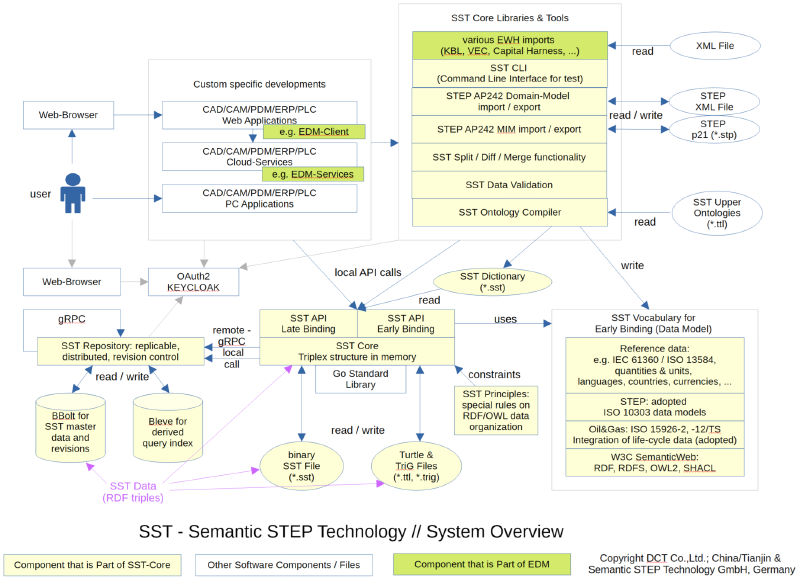
Major components of the SST Core are: #
-
SST Ontologies: A set of higher level ontologies on top of OWL 2, defining the underlying data model of SST. Basis is a Life-cycle Integration (LCI) ontology that is derived from ISO 15926 that allows a consistent representation of individuals with all their changes throughout space & time. On top of LCI other ontologies are provided for STEP (ISO 10303), Quantities and Units (ISO/IEC 80000), Reference Designation Systems (ISO/IEC 81346), Part Dictionaries & Libraries (ISO 13584 & IEC 61360) and more. Together the SST Ontologies provide an integrated single level data model that overcomes many limitation and artificial complexity of the underlying standards.
-
SST Data: All SST application data as well as the SST Ontologies is directly accessible as standard RDF exchange files (primarily in Turtle and Json-LD format) and is so available for other tools. However not every RDF file can directly be imported into SST as the data must be structured in a specific way to enable the overall performance and flexibility of SST. Part of this is that SST is not relying on any exhaustive reasoning/inferencing but instead requires a specific data organisation.
-
SST API : Application programming interface with the combination of the following unique features:
- completely written in GO programming language; the most efficient way for web applications
- late and early binding support. With early binding for each ontology concept a direct GO constructs are available; generated by the SST Compiler. This makes application programming straight forward
- triplex structure for being able to traverse an RDF graph that consists of triples in any direction
-
SST Core API/Library: A Semantic Web engine to support OWL 2 (and thus RDF, RDFS). Note that the SST Core is not a general purpose RDF toolkit as it is highly specialised for performance and the specific way how SST deals with application data. The build in triplex structure allows for fast traversing an RDF graph in any direction (starting from either subject, predicate or object). Implemented in Golang ensures fastest possible performance on cloud computers.
-
GIT like revision control capabilities to enable collaborative work on RDF data. GIT is very widely used system for software development, that provides a database for source code with strict revision control capabilities for each piece of source code. This includes commits, splitting the sources into branches and independent development, but being able to merge them afterwards. SST is providing the same kind of capabilities for NamedGraphs that define a set of triples (typically contained in an RDF file)
-
SST Repository: An integrated part of of the SST Core to make SST Data accessible on the Internet, together with built in revision control that follows principles of the GIT revision control system.
-
SST Repository ; either remote or local for the persistent storage of RDF data grouped into NamedGraphs and Datasets. A remote SST Repository is the default way for SST to publish data on the web
-
SST Converter:
SST Ontologies and SST Data organisation are publicly documented. SST Core, SST Repository and SST EDM are available on a commercial basis.